Tomorrow morning at 12 pm Eastern, the Pakistani national baseball team will take the field against Team Brazil in the Brooklyn Qualifier for the World Baseball Classic. For those of you who don't follow international baseball, Brazil has been a solid team for the last couple years and have some major leaguers, like Yan Gomes and Andre Rienzo. Pakistan on the other hand, is almost non-existent on the baseball stage. Pakistan is a small Muslim nation to the west of India, with zero baseball history or any players currently playing professionally anywhere in the world, and they are certainly the underdog in the four-team pool consisting of them, Brazil, Israel and the Great Britain. All three other teams have players in affiliated ball, with Israel boasting multiple players with big league experience. WBC rules do not state that one needs to hold a passport or have citizenship in a country to play, only to be eligible for citizenship in that country, making most Jewish players allowed to play for Team Israel. Pakistan, unlike the other teams, have not had any experience on big stages. The highest level of play have been against college players from Japan, Korea, and Taiwan several years ago in the Asian Games, although they have not fared very well against them, usually losing by 10-run margins. However, their most recent games have come against other baseball nations with little presence, such as India, Indonesia, Iraq, and Iran, and Pakistan has absolutely destroyed them. Scores like 20-nothing have not been uncommon. Despite having little experience and no affiliated players, the Pakistanis are not completely punchless. Outfielder Fazal Ur Rehman hit a homer against Iran, and Ubaid Ullah has been one of their best hitters against weaker teams, although he admittedly has struggled against better competition. One hitter who has kept up solid hitting against the better Asian teams is catcher Umair Imdad Bhatti, as well as Mohammed Sumair Zawar, whom the New York Times described as a "sparkplug", and infielder Jawar Ali won Defensive MVP of the 2015 Asian Games. On the pitching side, rumor has it that Ihsan Ullah can hit 90 mph, and he has held his own against Korea, Japan, and even threw a decent outing against China. Of course, none of these players compare to the stateside experienced players of the other three teams, all from much well-off nations with more money and resources. Pakistan doesn't even have a true baseball stadium in the country! But if there is anything the Pakistanis have, it's drive, desire, and the will to win. Even though they have not fared well against some of the better Asian teams, they have continued to battle their way into the #23 ranked spot in the world by the International Baseball Federation. They might not have the most talent, they have always battled and never given up. They play with so much heart and wear their emotions on their sleeves, and who knows, they might even surprise some people this coming week. Go Team Pakistan!
Everyone knows the five-tool players: Mike Trout, Andrew McCutchen, Bryce Harper. These guys are the big name superstars, the household names. Most other players are productive despite lacking a tool or two. David Ortiz can't field, Jose Altuve doesn't have a big arm, but they can still impact the game in many ways. Most one-dimensional players will wash out in the minor leagues. Cody Johnson was known for his prodigious power, but he couldn't do much else. Willians Astudillo may be the best contact hitter on the planet, but he's still toiling in Double-A. However, in very rare occasions, some players can make it to the major leagues riding on one skill alone. These 5 players below each have the ability to do one thing extraordinarily well, and somehow, its carried them into a major-league career. Contact: INF T.J. Rivera, New York Mets The long shot of all long shots, T.J. Rivera signed as an undrafted free agent out of little Troy University. Without any physical projection, Rivera was never considered much of a prospect. Not rated a tremendous defensive player, he has nonetheless held his own just enough to let his ultimate carrying tool, his bat, to carry him to the majors. Rivera has hit everywhere he's gone: a career .324 in the minors, .307 in 3 seasons of Puerto Rican winter ball, and now .344 in his first 61 at bats in the majors. He doesn't provide much pop, but he can spray line drives around the field and produce. And production is all that matters at the major league level. Power: "1B'" Chris Carter, Milwaukee Brewers Probably one of the worst defensive players in the National League and league leader in strikeouts, Carter has overcome overwhelming odds and is currently in his seventh major league season. It does help that he has prodigious right-handed power, and can hit the ball a long, long, way. With a simple cut through the zone, Carter can send flyballs 450+ feet for monstrous home runs. Certainly makes up for the 11 errors at first, 188 strikeouts, and -2.0 baserunning score on FanGraphs.
Speed: OF Terrance Gore, Kansas City Royals Used solely as a pinch runner in the playoffs, Gore provides no value to the Royals outside of his baserunning. Despite his speed, the Royals do not deploy him in the outfield during close games, nor let him hit considering his .563 OPS in AA. He does however, possess a single elite tool, and so far in his regular-season major league career has never been caught stealing. This one tool alone provides extreme value to Ned Yost and the Royals coaching staff late in important games, and it is the one skill that absolutely cannot be taught. He was once clocked at 22 mph when stealing second base:
Glove: 2B Christian Colon, Kansas City Royals A progressive small ball team, the Royals are the employers of another specialist, this time nifty defender Christian Colon. Originally drafted as a shortstop out of college, Colon lacked the arm or foot speed to stick at that position, and his bat never developed. Nonetheless, his plus glovework has taken him to the big stage. In just 247 innings at second base, Colon has compiled a 3.5 UZR, good for a 14.5 UZR/150 over the course of a full season. Its a shame however, that he likely won't get a shot to reach that potential due to his woeful .229/.288/.285 slash line.
Arm: C Christian Bethancourt, San Diego Padres Bethancourt has long been considered one of the top catching prospects in the game despite a light bat and below-average receiving and blocking skills. Scouts have doubted his inability to block pitches and frame. But if a catcher can't hit or field, how can he be a top prospect? Because those skills are teachable, and Bethancourt's one natural tool, his arm, is definitely elite. An absolute rifle, Bethancourt has been clocked at 96 mph on the mound and has a career 35% caught stealing rate. Rumor has it the Padres will trade him this offseason with hot prospect Austin Hedges coming up soon, but whichever organization ends up with him will have a potential-laden raw talent to develop. Here he is showcasing both his horrendous blocking but using his cannon arm to recover:
For the fourth time in five years, Mike Trout may not win the AL MVP award, despite yet another outstanding season by the Los Angeles Angel. Entering play Monday, Trout had put up a triple-slash of .312/.431/.546, accumulating 24 home runs, 21 stolen bases, 82 RBI’s and 98 runs. Defensively Trout has ranked about league average, but advanced metrics have been bullish on him in the past, and to the naked eye he can still impress with his glove. His base-running has been great, per usual, and looks to once again be in the running for AL MVP. Other candidates, like Mookie Betts and Jose Altuve, come and go from year-to-year, but Trout can always be counted on to be right in the thick of the race.
A friend of mine recently asked me, “How good is Mike Trout really?” Most people probably wouldn’t give much thought to this question, for Trout is the best, but it sure is a good one. In the context of baseball history, where is Mike Trout? I myself would like to know. Therefore, I decided to study up on this question so that I could provide a way-too-long-and-probably-unnecessary answer. For the purposes of this exercise, I will be looking at players primarily through their age-24 seasons, as Trout just turned 25 on August 7th, 2016 is considered to be in his age-24 season as well.
The first thing I would like to look at is how Trout compares to some of the best players of the last 30 years or so. The following graph compares the beginning of Trout’s career to 15 of the best players of the recent past, sorted by total WAR, through each player’s age-24 season:
As you can see, Trout is ahead of everyone; and frankly, it isn’t even close. The names on this list are nothing to joke about either. Despite what you may think about Alex Rodriguez, he is one of the 10-15 best position of all time. Ken Griffey Jr. was a first-ballot Hall of Famer, and Barry Bonds has more home runs than anybody in history. Even the names towards the bottom of this list, such as Carlos Beltran and Manny Ramirez, are potential Hall of Fame candidates. Essentially, based on WAR, Trout has shown better early-career production than any of the top position players of the past three decades.
For people who prefer not to rely strictly on metrics like WAR, I have gone through and highlighted the top three players in each stat category as well. I chose to exclude runs and RBI’s, as those numbers are partially related to a team’s batting order as a whole (although Trout did rank 2nd and 5th respectively in those categories). What should jump out at you is that no player on the list made it into the top three in any more than two stat categories, that is, other than Mike Trout. Trout, in fact, leads in double that number with four. Despite being tied for 6th on the list in batting average, he jumps up into 3rd place in overall OPS on the strength of a .402 OBP and a .558 SLG%. Furthermore, by placing top-3 in triples and stolen bases as well as in home runs, Trout demonstrates the speed/power combo that has made him such a standout player early in his career.
Now, let’s up the standards a bit and compare Trout to some of the best players of all time, again taking the accumulation of numbers through each players’ age-24 season (note that I have excluded Babe Ruth, who did not do much hitting prior to the age of 25)…
To continue reading this piece, and other highly-informative articles by Alex, please click here.
We all know the story. Signing a $100K minor league deal with the New York Mets, Tebow will now report to the instructional leagues this fall in an attempt to transition to baseball after a storied NFL career. It's been eleven years since he's played competitively, but he organized a showcase anyway. Miraculously, 28 teams and 40+ scouts showed up. The Mets supposedly liked his raw power, and inked him.
Supposedly.
I have no doubt that Tim Tebow is a great guy. His reputation as a tremendous clubhouse leader, a devout Christian, and a generous philanthropist follows him everywhere. When asked why he was taking a shot at baseball, he said that it wasn't a publicity stunt, he was simply chasing a dream, just like the thousands of other amateur ballplayers just looking to crack into the world of professional baseball player. But why has Tim Tebow, above everyone else, gotten a shot, while others are watching their childhood dreams get crushed and having to move on in life? The Mets (and Tebow's most supportive fans) say it is because of his athleticism, and the signing was purely a baseball decision. But let's be real here. Tebow was signed for publicity, to put fans in seats of minor league ballparks.
High quality Photoshop/DraftKings Playbook
I don't fault the Mets for signing him. $100K is nothing in baseball money, and that money will come back quickly if the fans are hooked by the novelty. And to be honest, he is a great athlete, and he can hit the ball a long way. Signing Tebow carries no risk and carries plenty of reward in revenue and media attention, and in the 0.000000001% chance he makes it... However, there is no need to sugarcoat this signing, and there is absolutely no need for fans to defend it. For all the pro baseball players who are upset and taking to social media to complain about it, they have every right to as well. Baseball is incredibly hard- the effort, the grind, the hours spent perfecting that swing off a tee, the hundreds of bullpens thrown to refine that control- is no joke. For one unlucky player, who has spent all their life chasing a near-impossible dream and is so close to making it, all their hard work over the years will be leapfrogged by a publicity stunt. And that is not fair.
"It's crazy how guys play all through high school, all through college, play independent ball and don't get that type of private showcase, and then he does. But that's the world we live in. Hopefully the Mets get out of it what they want, and hopefully he gets out of it what he wants." -Chris Archer, Tampa Bay Rays ace pitcher, whose signing bonus was similar to Tebow's
Tebow is a media event. A carnival attraction. A ploy to get fans to attend minor league games. And nothing more. Any attempt to convince fans that he is a real prospect will be shut down quickly, as evidenced by film from his showcase. Despite the build and what looks to be a cannon of an arm, Tebow's throwing is a 35, as are his footwork and routes when fielding. He runs well for a big man, but not well enough to influence games based on his legs alone. All his value will be tied to the bat, where his one plus tool, raw power, hopes to carry him. He can hit balls 440+ feet in BP, but his swing is grooved and unadjustable to pitches that aren't down the middle. Here is some footage of him taking fly balls. This was a showcase. Try to imagine that in a pro game.
Funny thing is, Tebow wasn't even the first athlete from a different sport to try and convert to baseball. Ever heard of Kieran Powell? The lefty-swinging world-class cricket player had private workouts with the Mets and the Brewers early in the spring. Powell, an opening batsman (sort of like a leadoff man), displayed good speed, a smoother swing than Tebow, and much better footwork in the outfield. While he too, was a non-prospect (awkward throwing motion, shoddy hands, only gap pop), his performance on the field could not be any worse than Tebow. Being younger (26 to Tebow's 29) and having played a hand-eye coordination, hitting related sport in the past decade, with a much smoother swing that can make decent contact, Powell would have had maybe even more potential. Powell, like Tebow, like the countless high school, college, and indy ball players out there, was just looking to chase a professional baseball dream. But why wasn't he signed? Because the name Kieran Powell has no meaning for American sports fans. Tim Tebow is an American hero. Name value alone has carried Tebow into the world of professional sports, leapfrogging Powell and all the other pro ball hopefuls along the way.
Ian Strom. Raphael Ramirez. Arnaldo Berrios. Jay Jabs. Jacob Zanon. Will Barring. Tucker Tharp. Joe Tuschak. Patrick Biondi. Champ Stuart.
These are the minor league outfielders in the low minors of the Mets organization, and they too, have no name value. Tebow's signing will cost one of them their job. Tim Tebow's signing is great for him, and for the Mets marketing department. Hell, they have a special schedule of Tim Tebow's appearance days in the instructional league specifically for the media. The whole signing is simply a marketing ploy, but for one of these outfielders, it means the end of their dreams. All their life, dedicated to baseball, will all be gone just like that. The fact that Tebow gets to keep his job as an SEC analyst while the others keep grinding away in the instructional league is just blatant disrespect; it's treating the dreams of others as a joke. Baseball is more than just a game for so many people. Baseball is a lifelong dream. And to have that stripped away for a marketing ploy, just so the media can go crazy to watch a former NFL hero take some hacks and get embarrassed by pro pitching, its simply unfair. None of this is Tebow's fault. Or the Mets fault. And it definitely isn't Strom's, Ramirez's, Berrios's, Jabs's, Zanon's, Barring's, Tharp's, Tuschak's, Biondi's or Stuart's. These guys gave their life to this sport. Baseball is a wonderful sport, but baseball is also cruel.
Bonus video: Domingo Ayala teaches us how to play beisbollike Tim Tebow. big tyne.
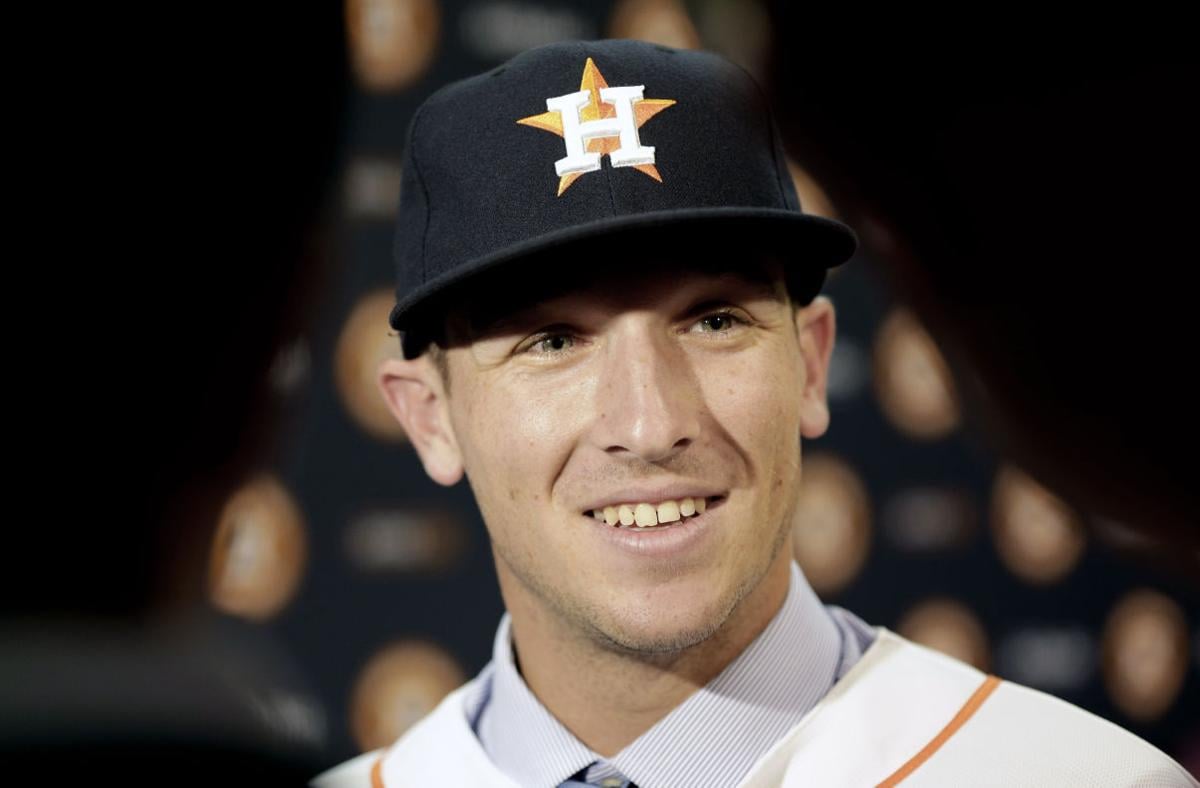
Right before a 3-game series against the New York Yankees, Jeff Luhnow and Co. of the Astros front office finally decided to to pull the trigger and call up Alex Bregman, arguably the top prospect in the game. His debut has been much anticipated by baseball fans everywhere, especially after lighting up AA and AAA pitching with an outstanding Futures Game performance in between. Here are 5 reasons that Bregman will instantly become a fan favorite as soon as he hits the big leagues:
1- He's got game
This first one is obvious. Bregman can hit, no doubt about it. After slashing a combined .306/.406/.580 with 20 HRs and a 47/38 BB/K in just 80 games between AA and AAA combined, he has shot up prospect lists so much that Keith Law calls him the top prospect in baseball. That short quick swing will spray line drives all over the field, and in the friendly confines of Minute Maid Park the power surge will hopefully continue. His bat will carry him, but the glove is amazing too. Range, hands, and arm, he's got it all. A solid defensive shortstop, he should be able to handle 3B just fine and LF in MMP probably won't be too hard for him. Here's a video of an insane play he made as a shortstop back at LSU.
2- He's got swagger
On the field, Bregman plays hard and is all business, but off the field he's got some flair. How many minor leaguers do you know have part in their own line of clothing and are already have endorsements? Alex Bregman is with Marucci baseball and they do Rake City Apparel, which you will find Bregman wearing a lot on Twitter and Instagram. You can buy their shirts here.
3- He's humble
For a 21 year old, Alex Bregman has tremendous professionalism when conducting interviews. Never citing individual goals, he has consistently focused on team winning and doing whatever he can do to help. Check out some of his interviews here and here. And even though on the field he is just as good or even better than many of his teammates, he knows his place as a rookie, as shown by this quote: “I’m going to keep my mouth shut,” Bregman said in his 11-minute introductory news conference. “The only thing I want to do is win games. I’m not going to win games by talking about it — just by doing it.”
Scouts often laud Bregman's grit and hustle, a lot of which comes from him playing with a bit of a chip on his shoulder. Coming out of high school, he declared that he wouldn't sign unless he was a first round pick. He wasn't taken until the 29th round, and sure enough, he headed to LSU instead. During his freshman year of college, he wore the number 30 for the thirty teams that passed on him.
5- He performs on the big stage
In each of his years in LSU, Bregman has played extremely well in the postseason, including a .533/.650/.667 performance in his sophomore year. In the Futures Game this year, he went 3-4 with a double and a triple. Usually calm and confident, his demeanor will bode well for his performance as the Houston Astros go down the stretch run and play some of the biggest games in Bregman's young career, and the Astros have brought him up to the majors with faith that his clutch performances will continue when they need it the most.
Long time no post! I have been busy with volunteer service in the baseball-crazed island of Taiwan, but without internet I have missed some important news. On July 14, the Red Sox dealt top pitching prospect Anderson Espinoza to the Padres for lefty Drew Pomeranz, and in part of a joint article with partner site MLB Sweet Spot, the two blogs will debate which team won the trade. Alex Vacca of MLB Sweet Spot has written up a detailed analysis defending the Pomeranz acquisition from the Red Sox side, click here to read it. His analysis is much more metrics-based as there is more data available for major leaguers, but despite being a numbers guy myself, this piece will focus more on the scouting side.
Dave Dombrowski has long been revered as a GM aggressive on the major league market. Back in his Tigers days, he led the Detroit squad to multiple playoff appearances through big-name trades and signings, acquiring the likes of Anibal Sanchez, Max Scherzer, Doug Fister, and Prince Fielder. It has, however, come at hefty prospect costs, and he left the organization with a depleted farm system with little impact talent. Now with Boston and with one of the league's deepest and most talented farm system at his disposal, he is free to return to his old dealing habits that brought him so much success. Trading away Espinoza, a top-15 prospect in the game, has been his biggest splash so far.
Anderson Espinoza shot up prospect rankings last winter after annihilating DSL and Rookie ball competition as a 17 year old. Hardly have Rookie ball pitchers ever been ranked so highly so quickly, but it is not hard to see why Espinoza is so special. At this age, many Latin teenagers flash potential plus fastballs with mid 90's velo, but they all have their warts due to youth and inexperience. Usually it is lack of command, underdeveloped secondaries, or just overall being a thrower instead of a pitcher. Espinoza, on the other hand, at just 18 years old, has a plus curveball and a tumbling change that is well beyond his years. Combined with a fastball that already reaches the upper 90's, hits triple digits, and has good spin and life, we are talking about a possible generational talent. His command could use a little more fine tuning, but for a teenager, the confidence and poise he has in his three pitch mix helps it play up. Espinoza is mechanically sound as well, with naturally fast arm speed that he matches on all three pitches to create deception. His delivery is basic and repeatable, with a clean arm action. He does a good job staying on balance and unlike his Latin teenage counterparts, hardly ever yanks off to the side in his finish. With a strong lower half, he is able to fire his hips to generate plus velo while still staying in control of his body and keeping the delivery repeatable. He also does a good job staying on top of the curve to ensure the big 12-6 break, and the change tumbles hard to the arm side. The curve is already a plus pitch, and the changeup has potential to be plus as well. Despite not having outstanding numbers at the A-ball level, keep in mind that he is the same age as a high school senior, and most players that age are still down in the GCL or AZL, much less full-season ball, and he has still been able to maintain a high strikeout rate regardless.
Drew Pomeranz is a great pitcher in his own right, an All-Star caliber lefty that has played on winning teams in Oakland. He can pitch, no doubt, and his development of a cutter has taken him from swingman to #2/3 starter status. In his breakout season this year, he has posted a 2.47 ERA, but a closer look at the circumstances show a switch from the AL to the NL and a move to the cavernous Petco Park. This goes along with a low BABIP and high strand rate, hinting that his current rate of success may not be sustainable. With a new third pitch, he has gotten better, and advanced metrics do show improvement as well, but a switch to the perennially tough AL East will determine just how much improvement. The biggest risk with Pomeranz, however, is the fact that he has never topped 100 innings ever in a single major league season. With the Padres, he has already thrown 103 in the first half alone. This begs the question: as a starter who moved to Petco Park and discovered sudden success, how much of his success can be attributed to actual development, and is the risk of acquiring a starter who has never even surpassed half a season's workload worth giving up possibly the best pitching prospect in all of baseball?
Fangraphs recently released an article breaking down the trade (worth a read, click here), and discussed that pitchers ranked on prospect lists in the Espinoza range generally average around 8.3 career WAR, with 28% of them having zero or negative career WARs. Pomeranz, even with regression, should be able to easily reach that same 8.3 mark in his 2.5 years of team control with Boston. But this doesn't account for the fact that prospect lists are highly subjective and also account for a prospect's proximity to the majors. As noted in the article, other pitchers ranked near him include Jose de Leon, Josh Hader, and Jose Berrios, all of whom have extensive minor league track records and have reached AAA. Espinoza ranked this highly straight out of the Gulf Coast League at age 17, truly a testament to the kind of raw talent and limitless upside he possesses. By the time he reaches AAA and develops some track record of his own, he might be in the conversation for top 10 prospect in the game, and average WAR for those pitchers jumps to 14.6, with zero percent posting negative career WARs. Anderson Espinoza is not just another young, hard-throwing Latin lottery ticket. Anderson Espinoza is an absolute phenom. Is it possible that he could fall short of the 8.3 WAR mark? Sure, all pitching prospects are volatile, but with his kind of devastating stuff he carries a higher floor than most others. And is it possible he hits his upside and absolutely blows past that mark en route to becoming one of the best pitchers in all of baseball with career value much more than what Pomeranz will provide to the Red Sox? Most definitely.
Usually when prospects are dealt for MLB players, the prospects are the risky ones and the big leaguer is a proven commodity. But when the major leaguer is a lefty who averages 91 on his fastball with a sudden breakout in Petco Park while topping just 100 innings for the first time, and the prospect is an 18 year old prodigy who has clean mechanics, a triple digit fastball, and not one but two plus offspeeds with command of all three pitches, who carries more risk? Dave Dombrowski is aggressive, and making this move could help them make a playoff push in David Ortiz's last season. A.J. Preller, the San Diego GM, has not been perfect in his tenure, but if this move pays off the way he hopes it will, with Espinoza fulfilling his lofty potential and Pomeranz falling back apart, San Diego may have pulled off one of the biggest heists in baseball in the 21st century.
To read Alex Vacca's post on MLB Sweet Spot about why the Red Sox won this trade, please click here.
Way back in October of last year during the Taiwan Series, I promised readers that I would write a follow-up piece on CPBL rookie sensation Po-Jung Wang. Unfortunately, I never got around to doing this, but no worries! Below is a piece by Brandon DuBreuil of cpblenglish.com, a site dedicated to the Taiwanese pro league, about Wang's rise to stardom and his chances of playing in the States. ... By Brandon DuBreuil
If you’re a baseball fan outside of Taiwan, chances are you’ve never heard of Wang Po Jung (王柏融). If you have, you probably only know him as the “bat-flipping maniac” as Deadspin recently dubbed him. While he does have one of the finest bat flips in all of baseball, he’s also one of the best young position players that this small island nation has ever produced. He’s a superstar in the making and a name that baseball fans around the world need to know.
Wang plays for the Lamigo Monkeys of the Chinese Professional Baseball League (CPBL) in Taiwan, where, as a rookie, he’s doing some pretty amazing things in a talented league made up mostly of veterans and ex-MLBers.
Take this as a starter: At the end of the 2015 season, before even qualifying as a rookie, he hit nine home runs in 111 at-bats. He then proceeded to break a CPBL playoff record with 14 hits in a seven-game series, helping lead the Monkeys to the Taiwan Series and taking home the award for the most outstanding player of the playoffs.
This all happened in his first two months as a professional baseball player.
It’s time for the baseball world to meet Wang Po Jung, and what better way to introduce him than to let the native of Pingtung, Taiwan, tell you who he models his game after.
“Bryce Harper,” he said confidently through a translator before a game in June. “We’re both outfielders and left-handed hitters. Mike Trout, too, though he’s right-handed.”
It might seem outlandish, but to call Wang Po Jung the Bryce Harper of the CPBL wouldn’t be that much of a stretch. Besides the comparisons Wang made, they’re both roughly the same age and both put up ridiculous offensive numbers.
Before we go too far with superlatives and crazy stats, let’s rewind and take a look at how a 22-year-old earned the nickname “King Po Jung” before even playing an entire professional baseball season.
To continue reading this piece as well as other insightful articles on the CPBL, click here. Bonus video: here is Wang going oppo-taco 13 rows deep (skip to 0:59). Crazy power to all fields

 Despite having little experience and no affiliated players, the Pakistanis are not completely punchless. Outfielder Fazal Ur Rehman hit a homer against Iran, and Ubaid Ullah has been one of their best hitters against weaker teams, although he admittedly has struggled against better competition. One hitter who has kept up solid hitting against the better Asian teams is catcher Umair Imdad Bhatti, as well as Mohammed Sumair Zawar, whom the New York Times described as a "sparkplug", and infielder Jawar Ali won Defensive MVP of the 2015 Asian Games. On the pitching side, rumor has it that Ihsan Ullah can hit 90 mph, and he has held his own against Korea, Japan, and even threw a decent outing against China.