Tuesday, July 26, 2016

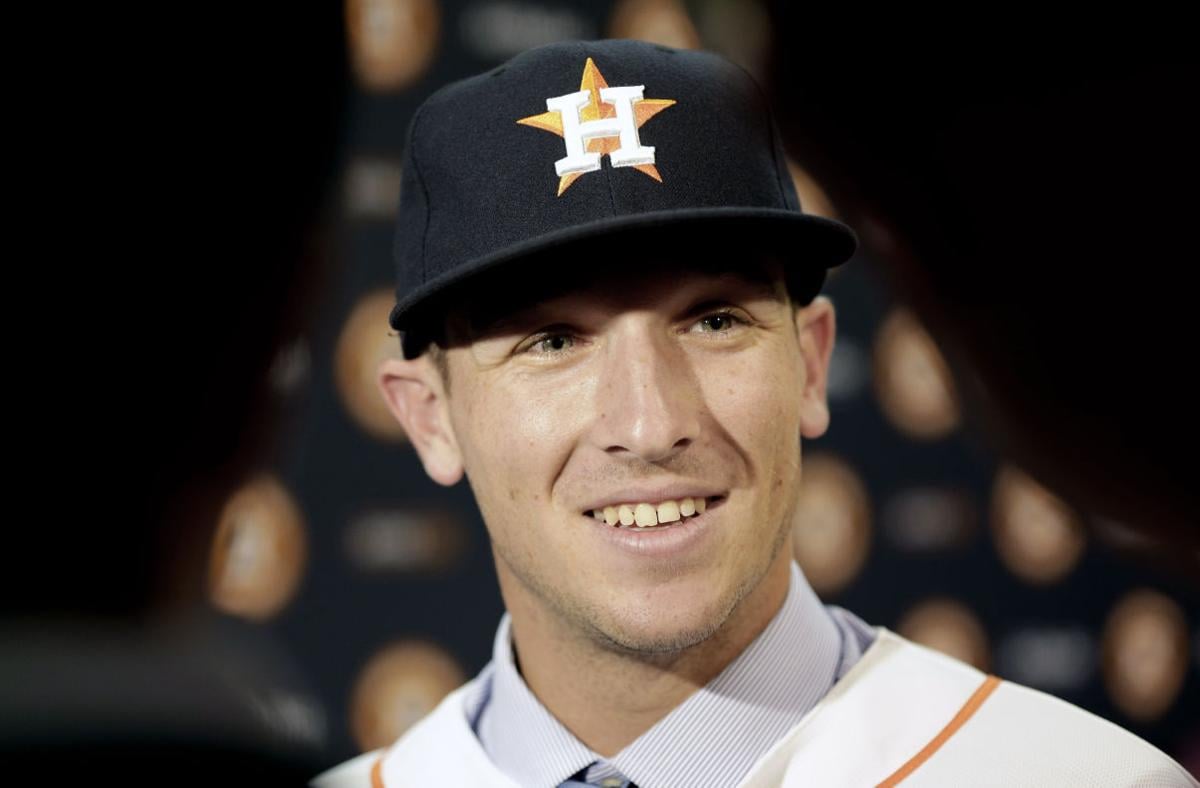
5 Reasons Why We Will All Love Alex Bregman

Alex Bregman, QCTimes
Right before a 3-game series against the New York Yankees, Jeff Luhnow and Co. of the Astros front office finally decided to to pull the trigger and call up Alex Bregman, arguably the top prospect in the game. His debut has been much anticipated by baseball fans everywhere, especially after lighting up AA and AAA pitching with an outstanding Futures Game performance in between. Here are 5 reasons that Bregman will instantly become a fan favorite as soon as he hits the big leagues:

1- He's got game
This first one is obvious. Bregman can hit, no doubt about it. After slashing a combined .306/.406/.580 with 20 HRs and a 47/38 BB/K in just 80 games between AA and AAA combined, he has shot up prospect lists so much that Keith Law calls him the top prospect in baseball. That short quick swing will spray line drives all over the field, and in the friendly confines of Minute Maid Park the power surge will hopefully continue. His bat will carry him, but the glove is amazing too. Range, hands, and arm, he's got it all. A solid defensive shortstop, he should be able to handle 3B just fine and LF in MMP probably won't be too hard for him. Here's a video of an insane play he made as a shortstop back at LSU.

2- He's got swagger
On the field, Bregman plays hard and is all business, but off the field he's got some flair. How many minor leaguers do you know have part in their own line of clothing and are already have endorsements? Alex Bregman is with Marucci baseball and they do Rake City Apparel, which you will find Bregman wearing a lot on Twitter and Instagram. You can buy their shirts here.

3- He's humble
For a 21 year old, Alex Bregman has tremendous professionalism when conducting interviews. Never citing individual goals, he has consistently focused on team winning and doing whatever he can do to help. Check out some of his interviews here and here. And even though on the field he is just as good or even better than many of his teammates, he knows his place as a rookie, as shown by this quote: “I’m going to keep my mouth shut,” Bregman said in his 11-minute introductory news conference. “The only thing I want to do is win games. I’m not going to win games by talking about it — just by doing it.”

USA Baseball
4- He plays to prove something
Scouts often laud Bregman's grit and hustle, a lot of which comes from him playing with a bit of a chip on his shoulder. Coming out of high school, he declared that he wouldn't sign unless he was a first round pick. He wasn't taken until the 29th round, and sure enough, he headed to LSU instead. During his freshman year of college, he wore the number 30 for the thirty teams that passed on him.

5- He performs on the big stage
In each of his years in LSU, Bregman has played extremely well in the postseason, including a .533/.650/.667 performance in his sophomore year. In the Futures Game this year, he went 3-4 with a double and a triple. Usually calm and confident, his demeanor will bode well for his performance as the Houston Astros go down the stretch run and play some of the biggest games in Bregman's young career, and the Astros have brought him up to the majors with faith that his clutch performances will continue when they need it the most.

Friday, July 22, 2016

Stealing a Phenom: How the Padres Won the Drew Pomeranz Trade

Drew Pomeranz, Hot Stove Soapbox
Long time no post! I have been busy with volunteer service in the baseball-crazed island of Taiwan, but without internet I have missed some important news. On July 14, the Red Sox dealt top pitching prospect Anderson Espinoza to the Padres for lefty Drew Pomeranz, and in part of a joint article with partner site MLB Sweet Spot, the two blogs will debate which team won the trade. Alex Vacca of MLB Sweet Spot has written up a detailed analysis defending the Pomeranz acquisition from the Red Sox side, click here to read it. His analysis is much more metrics-based as there is more data available for major leaguers, but despite being a numbers guy myself, this piece will focus more on the scouting side.

Dave Dombrowski has long been revered as a GM aggressive on the major league market. Back in his Tigers days, he led the Detroit squad to multiple playoff appearances through big-name trades and signings, acquiring the likes of Anibal Sanchez, Max Scherzer, Doug Fister, and Prince Fielder. It has, however, come at hefty prospect costs, and he left the organization with a depleted farm system with little impact talent. Now with Boston and with one of the league's deepest and most talented farm system at his disposal, he is free to return to his old dealing habits that brought him so much success. Trading away Espinoza, a top-15 prospect in the game, has been his biggest splash so far.

Anderson Espinoza shot up prospect rankings last winter after annihilating DSL and Rookie ball competition as a 17 year old. Hardly have Rookie ball pitchers ever been ranked so highly so quickly, but it is not hard to see why Espinoza is so special. At this age, many Latin teenagers flash potential plus fastballs with mid 90's velo, but they all have their warts due to youth and inexperience. Usually it is lack of command, underdeveloped secondaries, or just overall being a thrower instead of a pitcher. Espinoza, on the other hand, at just 18 years old, has a plus curveball and a tumbling change that is well beyond his years. Combined with a fastball that already reaches the upper 90's, hits triple digits, and has good spin and life, we are talking about a possible generational talent. His command could use a little more fine tuning, but for a teenager, the confidence and poise he has in his three pitch mix helps it play up. Espinoza is mechanically sound as well, with naturally fast arm speed that he matches on all three pitches to create deception. His delivery is basic and repeatable, with a clean arm action. He does a good job staying on balance and unlike his Latin teenage counterparts, hardly ever yanks off to the side in his finish. With a strong lower half, he is able to fire his hips to generate plus velo while still staying in control of his body and keeping the delivery repeatable. He also does a good job staying on top of the curve to ensure the big 12-6 break, and the change tumbles hard to the arm side. The curve is already a plus pitch, and the changeup has potential to be plus as well. Despite not having outstanding numbers at the A-ball level, keep in mind that he is the same age as a high school senior, and most players that age are still down in the GCL or AZL, much less full-season ball, and he has still been able to maintain a high strikeout rate regardless.

Drew Pomeranz is a great pitcher in his own right, an All-Star caliber lefty that has played on winning teams in Oakland. He can pitch, no doubt, and his development of a cutter has taken him from swingman to #2/3 starter status. In his breakout season this year, he has posted a 2.47 ERA, but a closer look at the circumstances show a switch from the AL to the NL and a move to the cavernous Petco Park. This goes along with a low BABIP and high strand rate, hinting that his current rate of success may not be sustainable. With a new third pitch, he has gotten better, and advanced metrics do show improvement as well, but a switch to the perennially tough AL East will determine just how much improvement. The biggest risk with Pomeranz, however, is the fact that he has never topped 100 innings ever in a single major league season. With the Padres, he has already thrown 103 in the first half alone. This begs the question: as a starter who moved to Petco Park and discovered sudden success, how much of his success can be attributed to actual development, and is the risk of acquiring a starter who has never even surpassed half a season's workload worth giving up possibly the best pitching prospect in all of baseball? 

Fangraphs recently released an article breaking down the trade (worth a read, click here), and discussed that pitchers ranked on prospect lists in the Espinoza range generally average around 8.3 career WAR, with 28% of them having zero or negative career WARs. Pomeranz, even with regression, should be able to easily reach that same 8.3 mark in his 2.5 years of team control with Boston. But this doesn't account for the fact that prospect lists are highly subjective and also account for a prospect's proximity to the majors. As noted in the article, other pitchers ranked near him include Jose de Leon, Josh Hader, and Jose Berrios, all of whom have extensive minor league track records and have reached AAA. Espinoza ranked this highly straight out of the Gulf Coast League at age 17, truly a testament to the kind of raw talent and limitless upside he possesses. By the time he reaches AAA and develops some track record of his own, he might be in the conversation for top 10 prospect in the game, and average WAR for those pitchers jumps to 14.6, with zero percent posting negative career WARs. Anderson Espinoza is not just another young, hard-throwing Latin lottery ticket. Anderson Espinoza is an absolute phenom. Is it possible that he could fall short of the 8.3 WAR mark? Sure, all pitching prospects are volatile, but with his kind of devastating stuff he carries a higher floor than most others. And is it possible he hits his upside and absolutely blows past that mark en route to becoming one of the best pitchers in all of baseball with career value much more than what Pomeranz will provide to the Red Sox? Most definitely. 

Usually when prospects are dealt for MLB players, the prospects are the risky ones and the big leaguer is a proven commodity. But when the major leaguer is a lefty who averages 91 on his fastball with a sudden breakout in Petco Park while topping just 100 innings for the first time, and the prospect is an 18 year old prodigy who has clean mechanics, a triple digit fastball, and not one but two plus offspeeds with command of all three pitches, who carries more risk? Dave Dombrowski is aggressive, and making this move could help them make a playoff push in David Ortiz's last season. A.J. Preller, the San Diego GM, has not been perfect in his tenure, but if this move pays off the way he hopes it will, with Espinoza fulfilling his lofty potential and Pomeranz falling back apart, San Diego may have pulled off one of the biggest heists in baseball in the 21st century.

To read Alex Vacca's post on MLB Sweet Spot about why the Red Sox won this trade, please click here.

Thursday, June 23, 2016

From CPBL English: Lamigo Monkeys' Wang Po Jung Is on a Path to Stardom

Way back in October of last year during the Taiwan Series, I promised readers that I would write a follow-up piece on CPBL rookie sensation Po-Jung Wang. Unfortunately, I never got around to doing this, but no worries! Below is a piece by Brandon DuBreuil of cpblenglish.com, a site dedicated to the Taiwanese pro league, about Wang's rise to stardom and his chances of playing in the States.
...
By Brandon DuBreuil
If you’re a baseball fan outside of Taiwan, chances are you’ve never heard of Wang Po Jung (王柏融). If you have, you probably only know him as the “bat-flipping maniac” as Deadspin recently dubbed him. While he does have one of the finest bat flips in all of baseball, he’s also one of the best young position players that this small island nation has ever produced. He’s a superstar in the making and a name that baseball fans around the world need to know.

Wang plays for the Lamigo Monkeys of the Chinese Professional Baseball League (CPBL) in Taiwan, where, as a rookie, he’s doing some pretty amazing things in a talented league made up mostly of veterans and ex-MLBers.

Take this as a starter: At the end of the 2015 season, before even qualifying as a rookie, he hit nine home runs in 111 at-bats. He then proceeded to break a CPBL playoff record with 14 hits in a seven-game series, helping lead the Monkeys to the Taiwan Series and taking home the award for the most outstanding player of the playoffs.

This all happened in his first two months as a professional baseball player.

It’s time for the baseball world to meet Wang Po Jung, and what better way to introduce him than to let the native of Pingtung, Taiwan, tell you who he models his game after.

“Bryce Harper,” he said confidently through a translator before a game in June. “We’re both outfielders and left-handed hitters. Mike Trout, too, though he’s right-handed.”

It might seem outlandish, but to call Wang Po Jung the Bryce Harper of the CPBL wouldn’t be that much of a stretch. Besides the comparisons Wang made, they’re both roughly the same age and both put up ridiculous offensive numbers.

Before we go too far with superlatives and crazy stats, let’s rewind and take a look at how a 22-year-old earned the nickname “King Po Jung” before even playing an entire professional baseball season.
To continue reading this piece as well as other insightful articles on the CPBL, click here.

Bonus video: here is Wang going oppo-taco 13 rows deep (skip to 0:59). Crazy power to all fields

Wednesday, June 15, 2016

Diamonds in the Rough: Two Foreign Draftees with Intriguing Backgrounds

During the MLB Draft, those who have played against international competition for Team USA have always been held in high regard. These platers are the ones considered to have great pedigree and a history of success, whether it be for the 18U Team (Mickey Moniak, Blake Rutherford, Forrest Whitley) or the Collegiate National Team (Corey Ray, A.J. Puk). Usually in the draft, the majority of the players hail from the United States, with a few scattered from Puerto Rico and Canada. There have been a few scattered players that were born in other nations as well and moved to the States for high school ball, but rarely, if at all, have they represented their home countries in global competition. In this year's draft, two players were selected with international tournament experience in a different country, Lyle Lin of Taiwan and Stjin van der Meer of the Netherlands.

C Lyle Lin (Taiwan), Seattle Mariners
Lin, 2011 with Chinese Taipei/ twbsball.org
Lin, a 6'2'' 200 pound catcher, was selected as a 16th rounder out of Junipero Serra Catholic High School in Southern California. Ranked as one of the top prep catchers in SoCal after moving stateside before his sophomore year, the Arizona State commit is a sold defensive catcher who has great bat speed to boot. A true two way catcher headed to ASU, Lin has drawn comparisons to former big-leaguer Paul Lo Duca. He is not expected to sign with the Mariners this year and will likely re-enter 3 years from now after some development in college, hopefully with a higher draft position. Back in 2011, Lin caught and batted 6th for the Chinese Taipei team that was the runner-up in the Pony World Series to Laredo, Texas. In the championship game, in which Chinese Taipei lost 10-9 despite a rally and runners in scoring position in the bottom of the seventh, Lin went 1-3 with a line drive single to left and reached twice on errors. Below is a video from Prospect Pipeline of his workout for the Area Code showcase.

SS Stijn van der Meer (the Netherlands), Houston Astros
van der Meer on Team Nederland, Honkballsite
Drafted out of Lamar University in the 34th round, van der Meer has the case to be the most interesting prospect in the entire draft class. Not only does he have the best, most exotic, and most consonant-excessive name, he also has the most unique background. Growing up in the Netherlands, which is not the most prospect-rich nation, van der Meer played baseball and was one of the top offensive producers in European tournaments, winning multiple awards along the way. Van der Meer was the MVP of the 2011 European Junior Championship, and the same year rated the #1 youth player in the nation. In 2012, at the age of just 19, he played in Netherlands top league, the Honkbal Hoofdklasse, against players 10-20 years older. (Some players get paid, some don't, which helped him retain NCAA eligibility.) He finished one shy for the league leader in hits, and started the All-Star Game as well. Following that season, he enrolled in college in the U.S, playing community college ball before transferring to Lamar, posting similar numbers as he did back home, usually with a batting average around .350 but with limited power. Every summer following college ball, he would return to his homeland and play Honkbal, and his gaudy stats are here on Baseball Reference. His career BB/K ratio is 38/20, and in college it is 57/28, so expect a patient hitter who will make contact as well. Also, because the Hoofdklasse is recognized as a major baseball organization, it is part of the baseball simulation game, OOTP 17, and with accurate rosters, the lanky shortstop even has his own profile! As seen on the OOTP Elite, Stijn is rated a 40 CON/25 POW, which is apparently good for a Honkbaler but non-prospect status for minor leaguers. But even if his incredible BB/K ratio doesn't hold up in pro ball, he can still strut his 4/1 consonant-to-vowel ratio in his first name, and as a Honkbaler named Stijn who played in a league called Hoofdklasse with his background, pedigree, and overall story, van der Meer should be a fun follow this summer and hopefully for years to come!

Tuesday, June 14, 2016

Go From Quad-A Hitter to Feared Slugger with One Simple Trick!

WCPO.com
After being a throw-in bench bat in a deal for a half-year rental starter, Adam Duvall has transformed himself from a Quad-A power guy to one of the best power hitters in baseball. Ranking second in the NL in home runs, Duvall has morphed into one of the only threats in a shallow Cincinnati lineup. Coming into this season, he was flailing away to a career .204 batting average despite displaying tremendous offensive prowess in the minor league levels. He always had very good bat speed that produced plus raw power, but he had trouble tapping into at the big-league level due to a whiff-prone approach at the plate and poor plate discipline, as well as some problems in his swing that have been solved. Let's take a look at some of the adjustments he has made to improve.

Adam Duvall's Pitch f/x Plate Discipline (courtesy of FanGraphs)
SeasonTeamO-Swing%Z-Swing%Swing%O-Contact%Z-Contact%Contact%Zone%
2014-2015Giants/Reds38.5 %70.5 %52.4 %52.9 %86.2 %72.4 %43.4 %
2016Reds41.9 %69.3 %54.6 %55.7 %84.2 %72.6 %46.6 %

Duvall has been knocked previously for his over-aggressiveness at the plate and chasing too many pitches out of the zone, so it would seem that his progress stems from being more selective at the plate, but looking at the numbers, this is not the case. Not only has he actually swung at more pitches (54.6% Swing vs. 52.4%), he has actually chased more often as well! The biggest difference is that instead of whiffing at the pitches he is chasing, he has put them in play, with a 55.7% O-Contact%, but even this is negligible because he has a lower Zone-Contact% this year, making his overall Contact% a 72.6%, not far from the 72.4% from before. Looks like improved plate discipline is not the cause of Duvall's breakout.

Adam Duvall's Batted Ball Data (courtesy of FanGraphs)
SeasonTeamSoft%Med%Hard%
2014-15Giants/Reds17.6 %48.4 %34.1 %
2016Reds16.3 %44.2 %39.5 %

Here we can see a marked improvement from previous years. By hitting balls harder than before, Duvall has been able to drive more balls over fences and produce one of the top slugging numbers in baseball. But that part is obvious. Every breakout season revolves around hitting the ball harder and with more authority, as it leads to more hits and homers. The question is, how has he done that?

“A mental adjustment,” Duvall said in an interview with the San Francisco Chronicle. “Staying on the ball a little longer, seeing the ball as long as I can, keeping the swing short and tight, focusing on driving the ball through the gaps and trying to be explosive when I make the decision to swing.”

The following gif is of Duvall homering when he was in the minors in the Giants organization. Notice how his hands make lots of noise in his load.

via GIPHY

The next gif is him homering this season against his old club. While it is from a different camera angle, we can notice that his hands in his load are now much simpler, a direct shift back instead of a down-and-up loop. His hips are also much more explosive through the zone, compared to the previous clip, where they rotate but with much less force.

via GIPHY

Simply by making one minor, almost unnoticeable mechanical transition, as well being mentally prepared to be more "explosive", Duvall has gone from a middling bench bat to a premier slugger. While his plate discipline could still use a lot of work (3.2% walk rate), he has already managed to make the necessary transitions to succeed in the majors. This is not to mention his giant leaps defensively, going from a mediocre defensive third baseman into one of the best defensive left fielders in the game right now (4.1 UZR, 10 DRS, 4 assists). Baseball is a game of inches, and sometimes minor adjustments can take you a long way. Give Adam Duvall credit for being able to make the necessary changes to progress his career to an All-Star caliber level.

Wednesday, June 8, 2016

Scouting Notes: Bakersfield Blaze vs. San Jose Giants 6/7/2016

Last night, thanks to free tickets available at the local Trader Joe's, I was able to catch the Bakersfield Blaze in town to play against the local San Jose Giants, both High-A affiliates in the California League. While I didn't get to the game until the second inning (sigh... Silicon Valley post-workday traffic), I got to see most of the action and make observations on each player who got in the game. The Giants featured several college draft picks from last season, all of whom have performed well and are rising quickly, while the Blaze were relatively prospect-light outside of Mariners #3 prospect (per mlb.com) Drew Jackson, but there were other intriguing talents as well.

Tyler Pike
Starting for the Blaze was Tyler Pike, a lefty who was taken in the 3rd round out of high school in 2012 as a projectable lefty. He mostly sat around 87-89 with the fastball, reaching back to hit 91 several times. Despite the velocity, it seemed to have get good life on that pitch, and was able to hit his spots reasonably well. He mixed in a changeup clocked around 80, but it wasn't anything special. The most impressive pitch, however, was his slow curve, clocked in the high-60's, low 70's that fooled San Jose hitters and had them whiffing. Overall, he pitched well in his four innings of work, striking out 4 and walking none, but he ran his pitch count up to 94 pitches (62 strikes) and had to be pulled despite being in line for the win. His command was not bad in this game, but with a career 5.1 BB/9 he might not make it to the majors as a starter. Pike had a deceptive delivery and good arm speed that consistently fooled lefties, but righties were able to see him well, so his ceiling may be a LOOGY with a nice curveball.

San Jose starter D.J. Snelten has had good results so far in his career, but it isn't hard to see why the big lefty (standing in at 6'7'') is not considered much of a prospect. His mechanics were iffy at best as he struggled to control his large frame, and despite his size only threw 85-88 on the fastball, keeping his pitches low and away in fear of leaving it over the heart. He slowed down his arm significantly every time he threw his offspeed pitches, and Bakersfield hitters were all over him, with 6 runs on 8 hits in 4.1 innings before giving way to the bullpen.

Austin Wilson was one of the hitters who did damage against Snelten, slicing a line-drive into the right field corner for an easy triple and 2 RBIs. Wilson is a physical beast but has struggled to adjust to pro pitching so far, batting .213 on the year, but as he went 3-3 tonight we will see if he has turned a corner. Drew Jackson, the highest-ranked prospect on the field, went 0-5, but with some loud flyouts to the warning track and mostly made hard contact, and while I didn't have a stopwatch on me he had definite wheels from home-to-first. He did, however, look great defensively, making a quick relay throw from left field to almost nab a runner at home that seemed like had no chance of being caught. 

Steven Duggar loads to swing.
On the San Jose position player side of things, three players stood out: first baseman Chris Shaw from Boston College, outfielder Steven Duggar from Clemson, and shortstop C.J. Hinojosa out of Texas. Shaw is having himself a great season at the plate, batting .294 and already with 12 dingers, and he went 1-4 last night with a single. He hit the ball hard every time he made contact, and displayed some pretty good plate discipline. Duggar was one of my top outfielders from last year's draft class, but he had some concerning issues in his swing that limited power production for someone who struck out a bit too much. This year, however, he seems to have bulked up quite a bit, hitting his 9th homer of the season to go with a nice 40/44 BB/K. His swing was one of the nicest on display last night, and he covered plenty of ground in center field as well. If his great play keeps up, look for him to shoot through the Giants system. Hinojosa is having a great year at the plate, and last night he looked like an absolute stud defensively, making a diving play in the hole on a hard-hit ball by Jackson, and then alertly throwing to third to nab the runner trying to advance. He had a nice, compact swing as well, and that should play well as he moves up the organizational ladder. On the other hand, he didn't hustle out any his flyouts, and lackadaisically played a high chopper off the bat of Kyle Petty that turned into an infield single. You would expect someone who played three years of college baseball under Augie Garrido at Texas to play with a little more grit. He did however, win a $50 gift card for a fan by breaking the headlights of an old truck as part of a promotion for auto repair, while teammate Jonah Arenado's throw bounced off the bumper and onto the field of play. Gotta love minor league baseball.

Other players to note:
- C Daniel Torres (BAK) called a good game and handled the pitching staff well, but struggled with blocking pitches in the dirt.
- LF Robbie Garvey (SJ) was your typical #9 slap hitter with an awful bat, but he could play some defense and could really run.
- Cuban outfielder Daniel Carbonell (SJ) DH'd tonight, and he is an absolute beast of an athlete. Baseball skills have yet to develop though.
- Also DHing was Blaze catcher Tyler Marlette (BAK). Former top prospect whose development is stagnating, wasn't very impressive at the plate.
- C Ty Ross (SJ) has an absolute cannon of an arm. Defense looked great, swing not so much.
- 3B Jose Vizcaino Jr. (SJ), drafted out of Santa Clara University, took some giant cuts and could hit the ball hard.
- RHP Jeff Soptic (SJ) threw the hardest pitch of the night, up to 97 on his heater, but has command issues and is now in his fourth year of A-ball.
- 1B Kyle Petty (BAK) went 3-5 to raise his average up to .346. Is already 25 though, and nothing about his game was particularly impressive.
- 2B Gianfranco Wawoe (BAK), pronounced wah-WOO, hit a monster foul bomb on a first pitch fastball before being over eager and whiffing on two straight sliders. Has some physical tools and an 80-grade name, but needs some polish.
- 3B Jonah Arenado (SJ), Nolan's little brother, was a defensive replacement and made some nice plays in the field. Strong arm was a bit out of control and Shaw had to save him twice. Hit a long fly ball to deep left in his one AB, only to be caught at the warning track. Bloodlines, but not much of a prospect.
- Arenado wasn't even the least-appreciated sibling at the game. 1B Justin Seager (BAK) is the unfortunate middle brother between Kyle and Corey, and is batting just .206 on the year. Didn't get in the game though.

Tuesday, June 7, 2016

Recapping My Picks from MinorLeagueBall's Community Mock Draft

This past weekend, I had the opportunity to participate in the Community Mock Draft at minorleagueball.com with accomplished prospect writers Nick Melotte of Today's Knuckleball, Benjamin Chase of Tomahawk Take, and of course the outstanding John Sickels. This was my first time participating in a draft of these sorts, with easily the smartest group of people I could have possibly gone up against. Acting as the Mock GM of the Houston Astros, I held picks #17, 61, 97, and 127 in this four round draft. In this piece below, I will break down and analyze each of my picks. Final results of the entire draft can be found here.

1-17 RHP T.J. Zeuch, University of Pittsburgh
Zeuch was on top of my board as the top college pitcher in the draft. While A.J. Puk deservedly gets more hype with his elite velocity, Zeuch has the most complete package. Standing at 6'7'', he is a big power arm who can throw a hard sinking fastball in the mid-90's that gets both whiffs (9.56 K/9) and grounders (76.4% GB rate). He has two breaking balls, both above average and usable in any count, as well as a promising changeup. Combined with his clean mechanics, arm speed, workhorse frame, and solid command (2.45 BB/9), it's a wonder why he doesn't rank higher on most draft boards and mocks. With my favorite prep target Forrest Whitley off the board, it made my decision to nab Zeuch a no-brainer.

2-61 LHP Ben Bowden, Vanderbilt University
I was really holding out that prep lefty Kyle Muller or Clemson catcher Chris Okey would fall to this pick, but there was no chance of that happening drafting against this group of opponents. All my other second round targets were long shots to fall too (Jeffries, Burnes, Kay, Rizzo, Kieboom) and were off the board. I was left between Reggie Lawson and Logan Ice, as well as third round target Ben Bowden, but as I realized there was no chance Bowden would fall to #97 I picked him up here. The big lefty has been Vanderbilt's closer this season, with great success, but he started 5 pre-conference games as well. Usually relying on his fastball and breaking ball, both potentially plus pitches, he also uses a changeup and cutter when he starts, although both are still developing. He definitely has the ability to start but can be fast-tracked to the bigs as a reliever. Upside is a #3 starter, floor is at least a big league set-up man. May be a reach based on most boards, but I see the big lefty as a value pick at 61.

3-97 RHP Reggie Lawson, Victor Valley HS (California)
After taking two pitchers, a righty and a lefty, I was looking for a bat here, but with my targets Lucas Erceg and Logan Ice both taken,  I ended up going with Lawson, a prep arm with signability concerns and had an injury-riddled spring that caused him to fall down boards. Because both players I took earlier were college arms, I figured that I could save some money to sign Lawson. He has one of the easiest deliveries in the class, mechanics advanced for a prep arm. His curveball and changeup both showed promise before, but backed up due to an oblique injury. When he rebounds from his injury, I believe that his breaking balls will come back to form, and with his command of his 90-94 mph fastball, the Arizona State commit should develop quickly for a high school pitcher.

4-121 SS Colby Woodmansee, Arizona State
Had to draft a hitter after picking three pitchers, and Woodmansee, who was my main fourth round target and highest hitter left on my board just so happened to be available. Middle infielders with power don't grow on trees, and Woodmansee has the pop to hit 10-15 HR's annually in the majors, if not more. After playing for Team USA last summer, he had a subpar spring, batting just .265 in the weak Pac-12, but his pedigree and potential was too much to pass up for me. If he had been taken, I would have gone with other Pac-12 players, USC catcher Jeremy Martinez or Stanford second baseman Tommy Edman.

If the real life Astros ended up actually drafting these four and be able to sign all of them, I would be ecstatic. Some interesting things to note in this community mock draft: personally I am not high on Virginia catcher Matt Thaiss, but John Sickels took him at 1-15 so he must be good. Dakota Mekkes was taken at 2-45, but a convincing argument by commenter ctcyawni convinced me that this was a great value pick. Connor Jones and Bryan Reynolds, both first round talents, fell to the compensation round, guess Minor League Ball isn't the place for boring, safe college guys. Max Guzman, mystery prospect to me, was taken with the last pick. He apparently has 80-grade raw power, so he should be a fun follow. Overall, it was a fun learning experience to pick up opinions and information on draft prospects from various intelligent baseball fans, and I enjoyed the challenge.